
Across the country, fraternity and sorority houses are often assumed to be protected under the broader umbrella of campus safety.
- Parents assume the university provides oversight.
- Alumni boards assume campuses deliver training.
- Students assume serious incidents “won’t happen here.”
- Law enforcement assumes they’ll respond if needed.
But here’s the reality: most Greek houses operate off-campus, are privately managed, and fall outside routine campus security frameworks. And that creates risk.
Preparedness in Greek life cannot be assumed; it must be built.

Why Greek houses face unique security challenges
Fraternity and sorority residences are not typical campus facilities. They are:
• Off-campus and outside routine patrol zones
• Designed for high occupancy and frequent social events
• Open to guests and non-members
• Operating with inconsistent access control
• Led by student officers who turn over annually
This environment increases exposure to unauthorized access and trespassing, assault or interpersonal violence, risky social dynamics, fire hazards, medical emergencies, and social media-driven escalation, all of which can intensify quickly in high-occupancy, socially active residences without structured prevention and response planning in place.
While the Jeanne Clery Act requires institutions to report campus crime statistics, private Greek residences often fall outside prevention planning structures, especially when houses are owned or managed independently.
Where the training gaps typically exist:
1. No formal security risk assessment
Many fraternity and sorority houses have never undergone a structured security assessment. Common overlooked vulnerabilities include:
• Entry points and door hardware
• Exterior lighting and visibility
• Blind spots and gathering areas
• Emergency equipment placement
• Internal shelter or lockdown zones
Without an environmental review, risk remains theoretical instead of actionable.
2. Emergency plans that don’t match the house
Generic campus emergency policies rarely translate directly to Greek housing realities. Frequent gaps include:
• No house-specific written emergency procedures
• No clearly defined leadership roles during crisis
• No reunification or accountability plan
• No coordination expectations with alumni boards
In an emergency, confusion costs time and time matters most in an emergency.
3. One-time, passive training programs
Too often, training consists of:
• A one-time online module
• General campus safety slides
• No hands-on rehearsal
Research consistently shows that interactive, scenario-based training improves retention and decision-making under stress, yet it is rarely delivered within Greek housing environments. Training should be specific to the environment, the emergency plan, and the types of risk that could occur at anytime throughout the year. Without repetition and realism, no student will take these training seriously or truly know how to respond if an incident were to occur.
4. Annual officer turnover
Greek leadership transitions annually, and without a structured safety framework in place, each new executive board inherits responsibility without inherited clarity. Critical knowledge about past incidents, vulnerabilities, and response expectations can be lost in the transition. Safety conversations often restart from the beginning, accountability becomes inconsistent, and momentum toward a proactive safety culture slows or stalls.
Preparedness cannot rely on informal handoffs or institutional memory alone. It must be documented, repeatable, and embedded into the operational structure of the house so that safety endures beyond any single leadership term.

The changing face of campus & Greek life security
Campus risk environments are evolving:
• Social media accelerates rumor and threat spread
• Mental health concerns intersect with safety incidents
• Off-campus gatherings create exposure outside university control
• Institutions face increased scrutiny regarding duty of care
Greek houses sit at the intersection of these realities. These communities are socially vibrant, densely populated, and often outside direct campus oversight. The question is no longer whether risk exists but if leadership is proactively addressing it.
What proactive Greek life security looks like
So what does meaningful preparedness look like inside a fraternity or sorority house?
It’s not a one-time presentation. It’s not a PDF sitting in a shared drive. And it’s definitely not hoping campus police will “handle it.” Real preparedness starts with clarity.
With our Operation Greek Shield Program, we work directly with Greek leaders, housing corporations, and alumni boards to move safety from assumption to action. First, we assess the house itself. That means walking the property, reviewing entry points, evaluating lighting, identifying blind spots, discussing realistic scenarios, and uncovering the small vulnerabilities that often go unnoticed.
Next, we build a plan that actually fits the house. Every chapter has a different layout, different culture, different social dynamics, and different leadership structure. Emergency procedures should reflect that reality. Who makes decisions in the first 60 seconds? Who calls 911? Who accounts for members? Who communicates with alumni leadership? When roles are defined ahead of time, hesitation decreases and response improves.
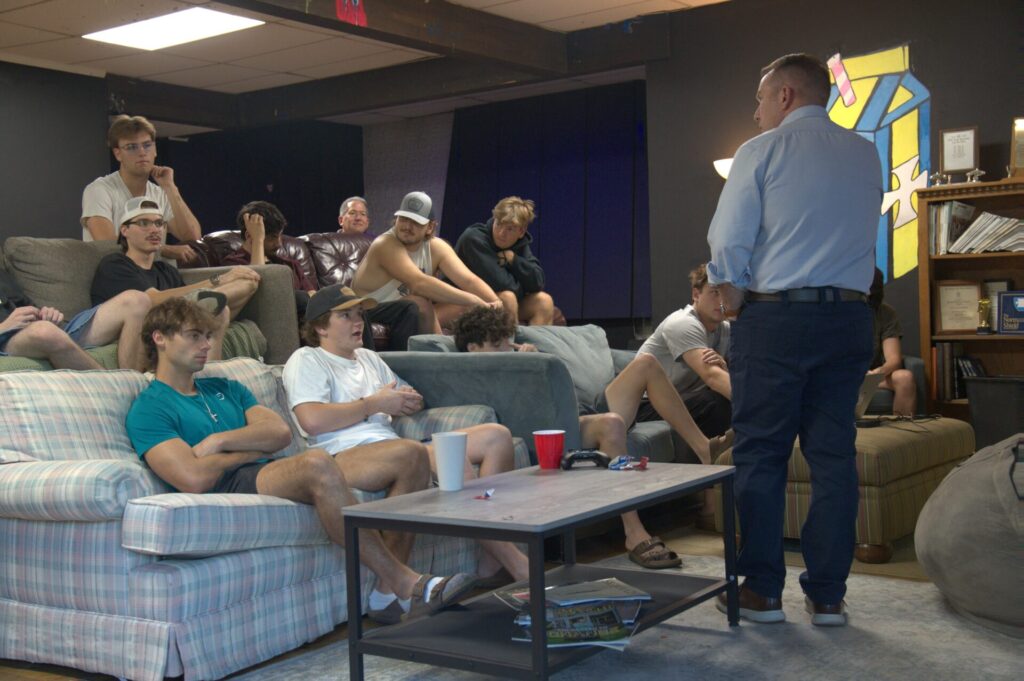
Then we train students in person, interactively, and with real scenarios that reflect what Greek houses actually experience. These include de-escalation conversations, medical emergencies, threats that surface online and spill into real life. When students practice these situations, confidence replaces panic.
Preparedness builds confidence, not fear
There’s a misconception that safety conversations create anxiety. In our experience, the opposite is true.
When student leaders understand what risks are most likely, not just worst case, they feel more in control. When they know exactly what to do in the first critical minutes of an emergency, they lead more effectively. Preparedness does not diminish the Greek experience. It strengthens it.

If your fraternity, sorority, or housing corporation has not conducted a formal security assessment or delivered house-specific emergency training, please reach out to learn how SEC can help.