Let’s be honest: there is a lot of noise coming at us right now. Between the non-stop headlines, the workplace shifts, and that general “static” of uncertainty in the air, it’s a lot to process. It isn’t just background noise anymore; it’s starting to change how we feel when we walk into the office or tuck our kids in at night.
I spent most of my career in the Secret Service, where assessing risk wasn’t just a skill, it was the air I breathed. You’re trained to spot the outlier in a crowd, to stay ice-cold when everyone else is panicking, and to make a move before a problem even becomes a problem. But as the years went by, I realized something: the best protective skills aren’t reserved for agents in suits. They are for parents, neighbors, and colleagues.
When my kids were growing up, I didn’t want to build a bubble around them. I wanted to build a compass inside them. I wanted them to live in awareness, not fear.


Separating the Noise from the Signal
In my world, we were taught to ignore what’s loud and look for what’s patterned. We are all exposed to emotional headlines and worst-case scenarios, but real safety comes from noticing behavior. It’s about asking: “Is this person just frustrated, or are they becoming fixated? Is this a one-time thing, or are they showing up where they shouldn’t be?”
Most situations never escalate. But when they do, there are almost always breadcrumbs left behind. The trick is learning to recognize when the pattern shifts from “normal life” to “something’s different.”
Awareness Isn’t a Stakeout
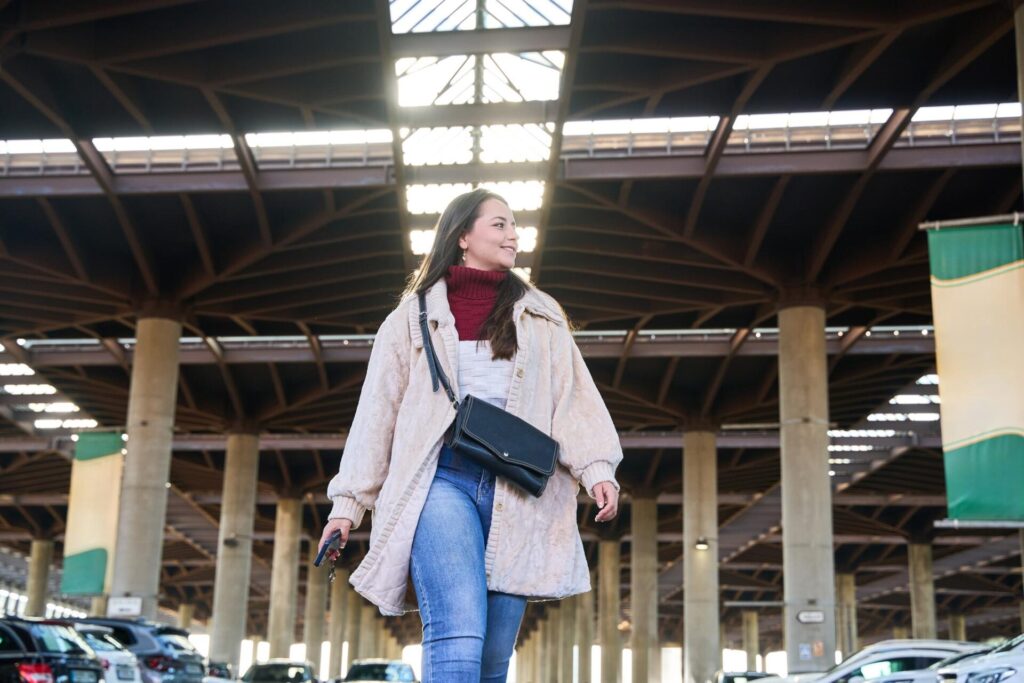
When I teach on “situational awareness,” people usually picture a guy with his back to the wall, scanning the room like a hawk. But that’s not how I live, and it’s not how you should live either. Real awareness is subtle. It’s a series of small, 3-second habits:
- Taking a quick beat to scan the room before you sit down.
- Look up and around in the parking lot, instead of scrolling through your social media or emails.
- Just being present enough to know who is around you.
I tell people all the time: you don’t need to be on high alert; you just need to be tuned in. That small shift changes everything about how you move through the world.
How We Did This at Home
I never wanted our kids to grow up afraid of the world, but I did want them to move through it with awareness and confidence. The way we do that is not by sitting them down and saying, “Here’s everything that could go wrong.”
It’s much more subtle. For example:
- When we walk into a hotel, I’ll casually ask:
“Hey, if we had to leave quickly, where would we go?” - In a parking lot, I might say:
“Let’s keep our heads up here…lots of movement.” - At a restaurant:
“What do you notice about this place?”
It turns awareness into a normal part of conversation and over time, they start doing it on their own.
The Power of Small Habits
A lot of people think “security” means big systems or major changes. In reality, it’s usually the small, consistent habits that matter most. Things like:
- Locking doors and windows, every time, not just at night
- Being mindful of what your kids (and you) are sharing online
- Having a simple plan for how to reach each other if something unexpected happens
- Knowing who belongs in your neighborhood, and who doesn’t
One example I often give is if your child’s after-school routine is posted publicly online every day, that creates predictability. And predictability creates vulnerability. Be aware of what you are putting out there for the world to see.
Lowering the Temperature
People are carrying more stress than ever, and you can feel it. Most “incidents” today don’t start as a movie-style threat, but they do start as tension. It could be a heated email from a customer, a frustrated parent at the baseball field, or an argument at the mall that gets personal way too fast. In those moments, you have a superpower: De-escalation.
Sometimes the most “tactical” thing you can do is lower your voice, take a step back, and refuse to “win” the argument. The goal isn’t to prove a point; it’s to reduce the risk.
If you take one thing away from my time in the Secret Service, remember that awareness should make you feel more confident, not more worried. You don’t have to change your personality, and you don’t have to assume the worst of people. You simply have to trust your gut a little sooner and pay a little more attention to the environment around you.
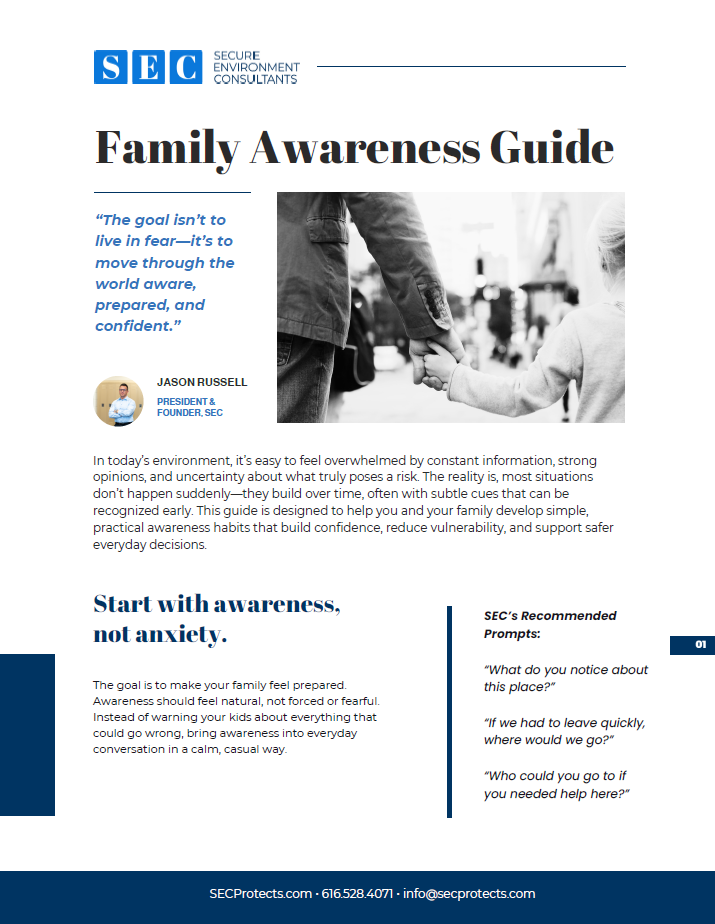
If you’re ready to start building this into your own family, we’ve put together something to help. Our Family Awareness Guide is a simple starting point for these conversations. It fits into your normal routine because, at the end of the day, this isn’t about changing how you live but being ready for whatever comes next.